Location
The Estonian Museum of Natural History is currently housed in an almost 150-year-old building in Tallinn’s Old Town at Lai Street 29a. From the street, the museum building is located in an inner courtyard, which visitors access through a characteristic Old Town passageway – a vaulted gateway. Upon entering the courtyard, the museum building is directly opposite the gateway. The building has one entrance, reached via a two-step staircase from the courtyard.
Historically designed as a residential building, the structure places significant limitations on the operation and accessibility of a contemporary museum.
Museum courtyard
Signage from the street directs visitors to the museum located in the inner courtyard, guiding them through a lush, urban-jungle-like garden to the museum building.
The museum’s green courtyard, together with a selected outdoor exhibition of plant communities, is accessible to wheelchair users and visitors with prams. During museum opening hours, the courtyard is open to everyone free of charge for visiting and spending time. Benches are located between raised flower beds, encouraging visitors to rest both body and mind.
In cooperation with the Estonian Assistance and Therapy Dogs Association and the Institute of Ecology and Earth Sciences of Tallinn University, we also organize a sensory garden for dogs in the museum courtyard – a day when visitors may come with their pets and offer them interesting scents to sniff and various textures to explore within the Old Town walls.
Every September, the museum hosts a Mushroom Exhibition in the courtyard, which allows visitors with mobility impairments and wheelchair users to visit the museum much more easily than the indoor exhibition spaces.
Visitors with wheelchairs or prams
Inside the museum building, movement between the three exhibition floors is possible only via narrow staircases – the building does not have an elevator or a platform lift. It is therefore not possible to move between floors with a wheelchair or a pram. Prams may be left in the museum courtyard.
Visitors with visual impairments
Inside the museum building, movement between the three exhibition floors is only possible via narrow staircases, and there is no guiding tactile path for visitors with visual impairments. Visitors may use their smart device to listen to the museum’s web-based audio guide.
For a better visitor experience, we recommend that visually impaired visitors come with a companion. Admission to the museum is free for people with severe or profound disabilities upon presentation of documentation, as well as for their companions. Trained guide dogs are welcome in the museum.
Visitors with hearing impairments
The museum’s video exhibits do not include sign language interpretation, and there is no induction loop system available.
Visitors with intellectual disabilities
In addition to independent or accompanied visits, the museum offers visitors with intellectual disabilities the option to book a separate group visit. Our museum educators tailor the programme according to the group’s interests and needs. To ensure the best possible experience, we recommend making a group booking by writing to @email.
In planning the new museum building, we are placing special emphasis on improving accessibility and supporting the museum experience of visitors with different types of disabilities. More information can be found below.
Movement guidance and spatial description for visitors with visual impairments
The exhibitions of the Estonian Museum of Natural History are located on three floors of the building.
The museum ticket desk is located on the first floor, directly opposite the entrance. A self-service cloakroom is in the same space, immediately to the right of the entrance door. The museum shop is located to the left upon entering; to purchase items displayed in glass cabinets, please contact the ticket desk. Toilets, including an accessible toilet, are also located on the first floor, past the ticket desk. The accessible toilet includes a changing table and a child-sized toilet. Free hygiene products for women and children—sanitary pads, wet wipes, and diapers—are available in the museum restrooms.
Turning right from the ticket desk, a six-step staircase leads to the mezzanine floor. In the short corridor on the mezzanine, there is a built-in aquarium on the right-hand wall. At the end of the corridor, on the right, is the museum’s seminar and birthday room. From the end of the corridor, visitors can access the temporary exhibition hall straight ahead and to the left.
At the beginning of the mezzanine level, an L-shaped staircase ascends on the left. The staircase is lined with aquariums and also functions as the museum’s stair gallery. Upon reaching the second floor, the first door on the left leads to the geology exhibition, which introduces the geological history of Estonia. In the wall directly opposite the stairs is a built-in display case featuring highlights from the museum’s collections, with exhibits changing seasonally. Next to it is the entrance to the bogs exhibition hall. The stair gallery continues along the second-floor corridor, where one wall imitates the Estonian limestone cliff (klint). Suspended from the ceiling is a cardboard model of a nautiloid, an ancient marine creature.
The gallery continues via another L-shaped staircase, which leads visitors from the end of the corridor on the right to the third floor.
Upon reaching the third floor, the door on the left leads to the museum classroom. Straight ahead from the stairs is the forest exhibition hall, and to the right is the audiovisual immersive exhibition “Tuur Maria’s Dream.” Due to its audiovisual design, this exhibition space is dimly lit, and visitors are advised to move with caution. Along the right-hand wall of the room is stepped seating. Upon entering the exhibition, visitors are asked to leave their shoes under the benches near the entrance. The third-floor corridor also features an exhibition related to the Baltic Sea.
The visitor route ends on the third floor.
Sensory solutions
Visual – texts and lighting
The permanent and temporary exhibitions are accompanied by explanatory texts. Text size and lighting conditions vary depending on the exhibition content. Due to its audiovisual concept, the “Tuur Maria’s Dream” exhibition hall is dimly lit. Interactive screens are also used in some areas of the museum.
Auditory – audio guide
Using a personal smart device, visitors can listen to the museum’s web-based audio guide. The free audio guide is available in Estonian, Russian, English, and Finnish. It can be accessed via a web browser on any internet-enabled device (phone, tablet, or laptop) without downloading an app. Free public Wi-Fi is available in the museum. Assistance with starting the audio guide can be requested at the ticket desk.
The audio guide is available for the permanent exhibition, temporary exhibitions, and the autumn mushroom exhibition in the courtyard.
Sounds in the exhibitions
In addition to the audio guide, ambient soundscapes are present throughout the museum – birdsong can be heard on all three floors. In the temporary exhibition hall on the first floor, visitors can listen to Fred Jüssi’s reflections using headphones in the “peace corner.” The immersive exhibition “Tuur Maria’s Dream” on the third floor is designed as an audiovisual experience accompanied by continuous sound during the 20-minute session.
Touch-based experiences
The permanent exhibition includes hands-on exhibits that enrich the sensory experience: various rocks and fossils in the geology exhibition; wet and dry bog peat, bog iron, and pine cones in the bog exhibition; and tree trunks of local species and a bear specimen in the forest-meadow exhibition. Interactive activities are integrated throughout the exhibitions, encouraging visitors to engage hands-on. Exhibits intended for touching are clearly marked, while those for viewing only are protected. Taxidermy specimens, herbarium sheets, and other rare collection items are safely displayed behind glass or rope barriers.
Scents
In the bog exhibition hall, visitors can experience the scent of marsh rosemary.
Seating
Seating is available in the museum courtyard, foyer, and exhibition halls, including benches and chairs with back support.
How to get here?
On foot
From Town Hall Square, the museum is a 5-minute walk. Walk through Saiakang, cross Pikk Street, pass through Börsi Passage, and turn right onto Lai Street. The Estonian Museum of Natural History is located at Lai 29a, on the left-hand side in an inner courtyard.
From Kalamaja (e.g. Balti Jaam), the museum is a 10-minute walk. Head towards the Old Town, cross Toompuiestee–Rannamäe Road, turn left, and walk through Tornide Square park to Suurtüki Street. Turn right and continue between the Köismäe and Plate towers along Suurtüki Street to Lai Street. Turn right; the museum is located at Lai 29a, in the first courtyard on the right.
From the seaside (e.g. Old Harbour), the museum is a 15-minute walk. Walk along Kai or Sadama Street, cross Mere Boulevard, turn right, and walk up Rannamäe Road toward the historic Fat Margaret tower. Continue along Pikk Street to Tolli Street, turn right, and at the end of Tolli Street turn left onto Lai Street. After passing St. Olaf’s Church and Suurtüki Street, you will see signage directing you to the museum courtyard on the right.
By bicycle
A spacious bicycle parking area is available in the museum courtyard, including space for cargo bikes.
By Car
The museum does not have its own parking lot. The nearest parking areas are:
Street parking on Lai Street is in the Old Town zone (€6/hour).
By Public Transport
The museum is easily accessible by public transport and is a short walk from Balti Station, Suure Rannavärava tram stop, and the Linnahall and Rannamäe Road bus stops.
From Balti jaam 10 minutes
- train;
- trams nr 1, 2 and 5;
- buses nr 2, 3, 21, 21B, 41, 41B, 59, 84 and 85.
From Linnahall /Suure Rannavärava stops 11 minutes
- trams nr 1, 2 and 5;
- buses nr 3, 20, 21, 21B, 41, 41B and 73.
From Rannamäe tee stop 7 minutes
- buses nr 102, 114, 115, 173 and 174.
Accessibility in the New Museum
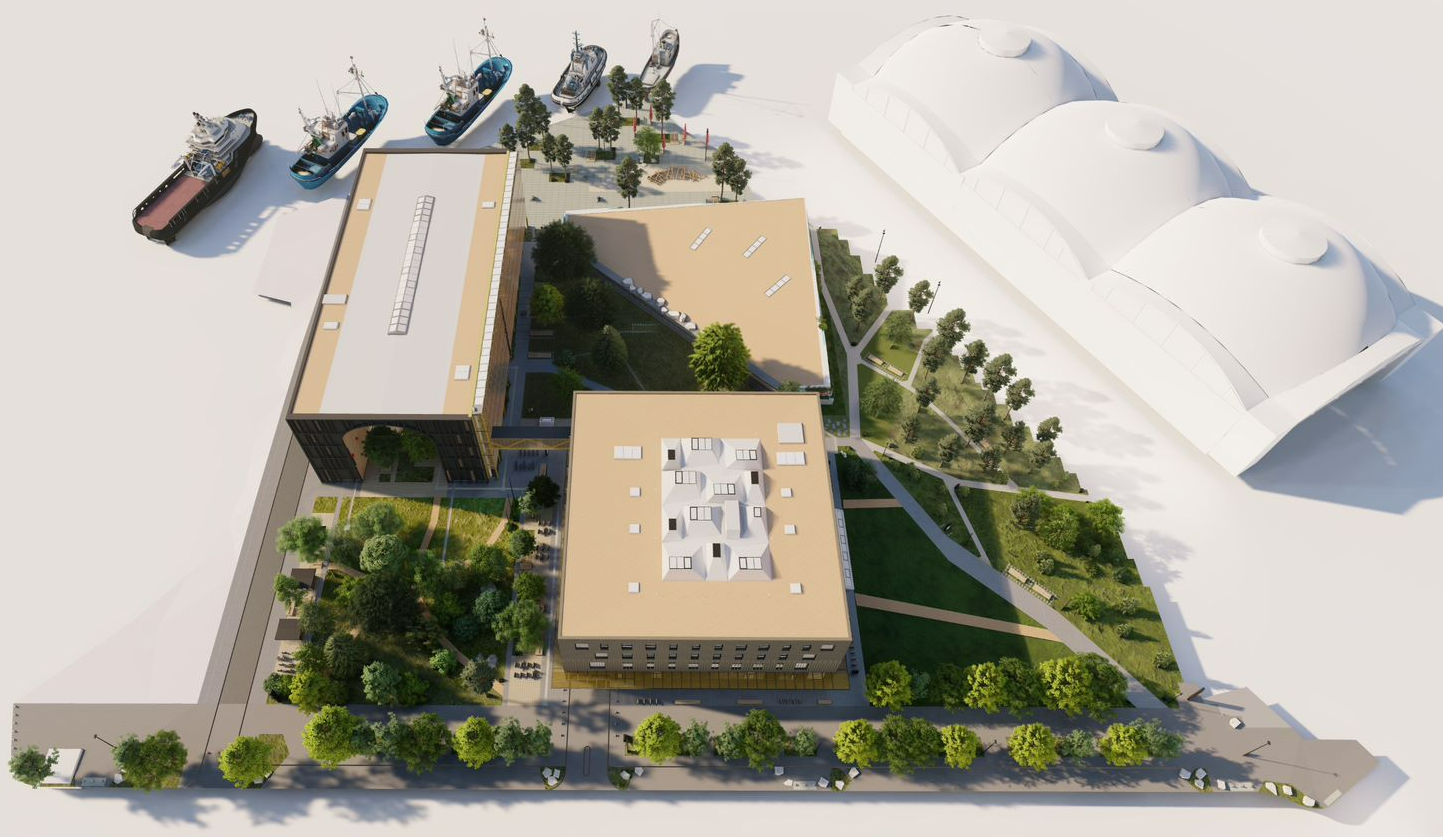
In 2027, the Estonian Museum of Natural History will reopen in a renewed form in Loodusmaja, the largest public wooden building in the Baltic States, currently under construction in Noblessner.
The new museum is designed around a holistic visitor experience and will be fully accessible to everyone. Everyone has the right, opportunity, and freedom to engage with nature-related topics, discuss, ask questions, and find answers. Exhibitions will be accessible to all age groups and will engage multiple senses. Exhibition content will be clear and easy to understand, and spaces will be comfortable to navigate. Disability will not be a barrier. The exhibition route will be safe, with clear signage, accessible toilets, a variety of seating options, and parent–child rooms.
Accessibility in the new museum will encompass physical space design, information design, and service design as a whole. We take a life-course approach that includes people of all ages, with particular attention to visitors with special needs, older adults, parents of young children, and children. We consider mobility, visual, hearing, and intellectual disabilities.
The new museum will also feature a dedicated children’s exhibition area, designed with child-appropriate content and spatial solutions, accommodating various special needs. Exhibitions will be accessible through multiple senses and navigable both on foot and with mobility aids.
Unlike the current museum, the Loodusmaja complex will include a restaurant, allowing visitors to dine in addition to visiting the museum.
Outdoor space and landscaping will play an important role in connecting the buildings within the Loodusmaja complex. The landscaping will serve as an experiment, aiming to establish various plant communities characteristic of Estonian nature. The outdoor area will function as an outdoor learning environment and will be freely accessible to visitors.